
A draft and a gain
These sources do not name a universal surplus in kilocalories, so a resting draft cannot be turned into an add-on for everyone. Gain is watched through a run of mornings, strength days, and food quality, not through a round number stacked on top.
What the sources do not contain
The Mifflin equation estimates rest: +5 at the end for men, −161 for women, and it is not a measurement of what was eaten and not a prescription. The line has no field for “add some on top.” This page does not insert a personal surplus and does not flip the CDC loss pace to invent a gain pace.
The ScanDish steps 1.2, 1.375, 1.55, and 1.725 only scale the resting estimate. A larger step is not permission to eat beyond the log and is not equal to a surplus. If the app shows a draft higher than what feels familiar, that is not yet a plan for gaining mass.
Mornings and strength days
A run of morning weigh-ins shows whether weight is moving across weeks, not whether one hearty dinner happened. A log of food, drinks, activity, sleep, and stress, as CDC asks, is needed here too: the formula does not see the plate. A fast jump amid illness, medicines, or stress is a reason to see a clinician, not a reason to declare the gain a success.
Strength stands on its own line. For adults 18–64, WHO places muscle-strengthening on two or more days beside 150–300 minutes of moderate aerobic activity or 75–150 minutes vigorous. CDC keeps at least 150 minutes of moderate aerobic activity and the same two or more strength days. Aerobic minutes do not dissolve the strength line.
Food quality on a fuller plate
A fuller plate still lives inside the WHO fact sheet: fruit and vegetables at least 400 g a day, fat under 30% of energy, saturated fat under 10%, trans fat under 1%, salt under 5 g. Unsaturated fats — fish, avocado, nuts, vegetable oils — are preferred to saturated and industrial trans fats. Free sugars stay under 10% of energy, and under 5% brings further benefit.
MyPlate and the Dietary Guidelines add their own outline: half the plate fruits and vegetables, half of grains whole, varied protein foods, low-fat or fat-free dairy or fortified soy. Added sugars under 10% of calories from age 2, sodium under 2,300 mg a day. Gain does not cancel those shares and does not allow the extra energy to be closed with a sugary drink alone.
Protein as a population figure
The safe protein level for adults in FAO/WHO/UNU is 0.83 g per kg of body weight per day. That is a population figure, not a muscle-gain plan and not a split across meals. Kidney disease changes the figure through a clinician, and this article does not prescribe a dose.
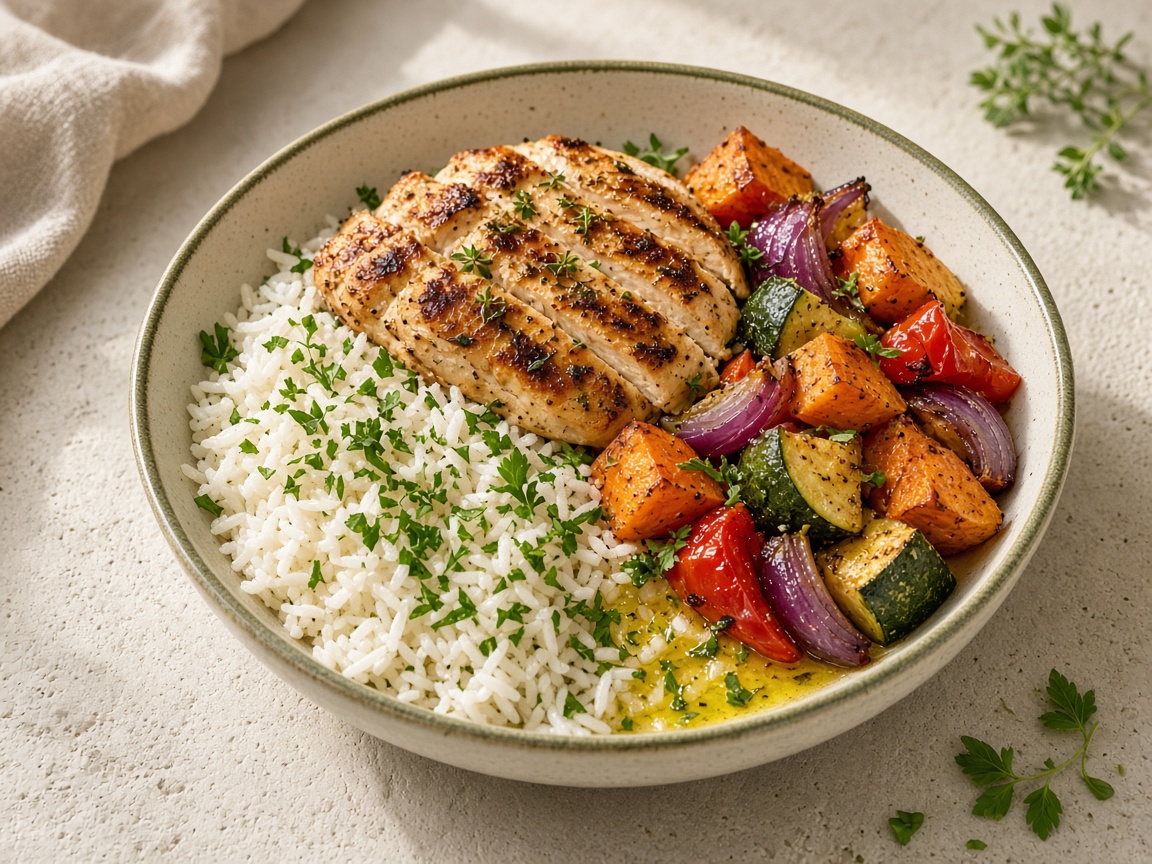
Varied protein foods on the plate — fish, poultry, beans, dairy — sit closer to the MyPlate wording than the same cut at every dinner. Fiber does not disappear meanwhile: for adults, WHO names at least 25 g a day from food. A gain that pushed vegetables out has stopped being a continuation of these sources.
What this text draws on
- Mifflin M. D. et al., Am J Clin Nutr, 1990; 51(2):241-247: a resting estimate. Men (10 × kg) + (6.25 × cm) − (5 × age) + 5. Women the same with −161 instead of +5. Not a measurement of what was eaten and not a prescription.
- CDC, Steps for Losing Weight (January 17, 2025): a gradual pace of about 1 to 2 pounds a week is more likely to be kept than quicker loss; losing 20 pounds in 2 weeks is the example of an unrealistic goal. Modest loss, CDC’s example: 5% of 200 pounds is 10 pounds, can improve blood pressure, cholesterol, and blood sugar and could lower risk of heart disease, prediabetes, and type 2 diabetes — not a personal guarantee. Log food and drinks, activity, sleep, and stress. Goals are specific, two or three at a time; examples include water instead of a sugary drink, a 15-minute walk, a vegetable with supper. Setbacks are expected. Rewards are not food. Medicines, illness, stress, genes, hormones, environment, and age affect weight. Weight and medicine questions go to a clinician. Medicines and bariatric surgery are clinical options, not DIY.
- WHO Physical activity fact sheet: adults 18–64 at least 150–300 minutes of moderate aerobic activity a week, or 75–150 minutes vigorous, plus muscle-strengthening on 2 or more days; some activity is better than none; sedentary time should be limited. From age 65, the same plus balance and coordination on 3 or more days.
- CDC, Adult Activity: at least 150 minutes of moderate aerobic activity a week and muscle-strengthening on 2 or more days.
- WHO Healthy diet fact sheet: energy intake in balance with expenditure; fruit and vegetables ≥400 g/day; free sugars <10% of energy (below 5% for further benefit); fat <30%; saturated fat <10%; trans fat <1%; salt <5 g/day; unsaturated fats (fish, avocado, nuts, vegetable oils) preferred to saturated and industrial trans fats.
- Dietary Guidelines for Americans, 2020–2025, and USDA MyPlate: a nutrient-dense pattern shaped by culture and budget; added sugars <10% of calories from age 2; saturated fat <10%; sodium <2,300 mg/day; half the plate fruits and vegetables; half of grains whole; varied protein foods; low-fat or fat-free dairy or fortified soy. Drinking less is better than drinking more; not drinking is an option.
- FAO/WHO/UNU, 2007: the safe protein level for adults is 0.83 g per kg body weight per day. A population figure, not a muscle-gain plan. Kidney disease changes it through a clinician.
- WHO carbohydrate guideline, 2023: at least 25 g of fiber a day for adults, from food.
A short paraphrase of open guides and reviews (WHO, national recommendations, peer‑reviewed summaries). Not a quotation and not a treatment protocol.
Short answers
What surplus should be added to the draft?
The sources give no ready-made addition in kilocalories. Watch the run of mornings, the strength days, and the food log.
Is 0.83 g of protein per kg a muscle-gain scheme?
No. It is the safe level for adults as a population figure. A muscle plan and any kidney-disease adjustment go through a clinician.
