Salt and sodium apart
The WHO fact sheet limits salt: under 5 g a day. The American guidelines and the DASH plan speak of sodium: under 2,300 mg a day, and DASH also has a 1,500 mg version. These are different documents and different quantities, and this page does not fold them into one figure.
Salt on the WHO sheet
The salt line stands in the same row as energy, vegetables, sugars, and fats: under 5 g a day. It means salt that comes from cooking, from bread, from sauce, and from food that is already salty, not only the pinch over a finished plate. Five grams is a population limit for the day, not permission to salt one dish “to taste” and ignore the rest of the day.
A soup in which the salt went into the broth, and bread eaten every day, spend this limit just as the salt shaker does. Fried and packaged foods often carry salt quietly, because the taste was built by the maker. A few days of food notes show where salt repeats, better than an argument about one lunch.
Sodium in the American lines
The Dietary Guidelines name sodium under 2,300 mg a day beside added sugars and saturated fat. The DASH plan describes sodium at 2,300 mg, or a 1,500 mg version, in a pattern of vegetables, fruit, whole grains, low-fat dairy, fish, poultry, beans, nuts, and vegetable oils. The plan was studied for blood pressure.
DASH is not a crash-loss scheme and not permission to eat everything. The choice between 2,300 mg and 1,500 mg, for a person already treated for blood pressure, is not made from an article: CDC sends questions about weight, blood pressure, and medicines to a clinician. This page does not give millimeters of mercury.
Why this page does not convert one into the other
Five grams of salt and 2,300 mg of sodium cannot be set equal to each other. They have different names, different units, and different sources. Any kitchen conversion that declares these lines to be the same limit goes beyond the text of both documents, and it is not used here.
On an FDA label, sodium is shown per serving, and a package can contain several servings. A labeled serving is not always 100 g. Even when a package states sodium in milligrams, that is not a formula that turns the WHO line of 5 g of salt into the American line of 2,300 mg. Read the line that the document in front of you actually states, and do not swap in the neighboring one.
Where salt is obvious without any conversion
The salt shaker, a broth cube, sauce, cheese, bread, and ready-made fried food are where the day’s salt usually gathers. They can be noticed by taste and by the ingredient list, without translating grams of salt into milligrams of sodium. If the day is already salty by morning, the evening pinch is not a separate subject. It continues the same 5 g limit.
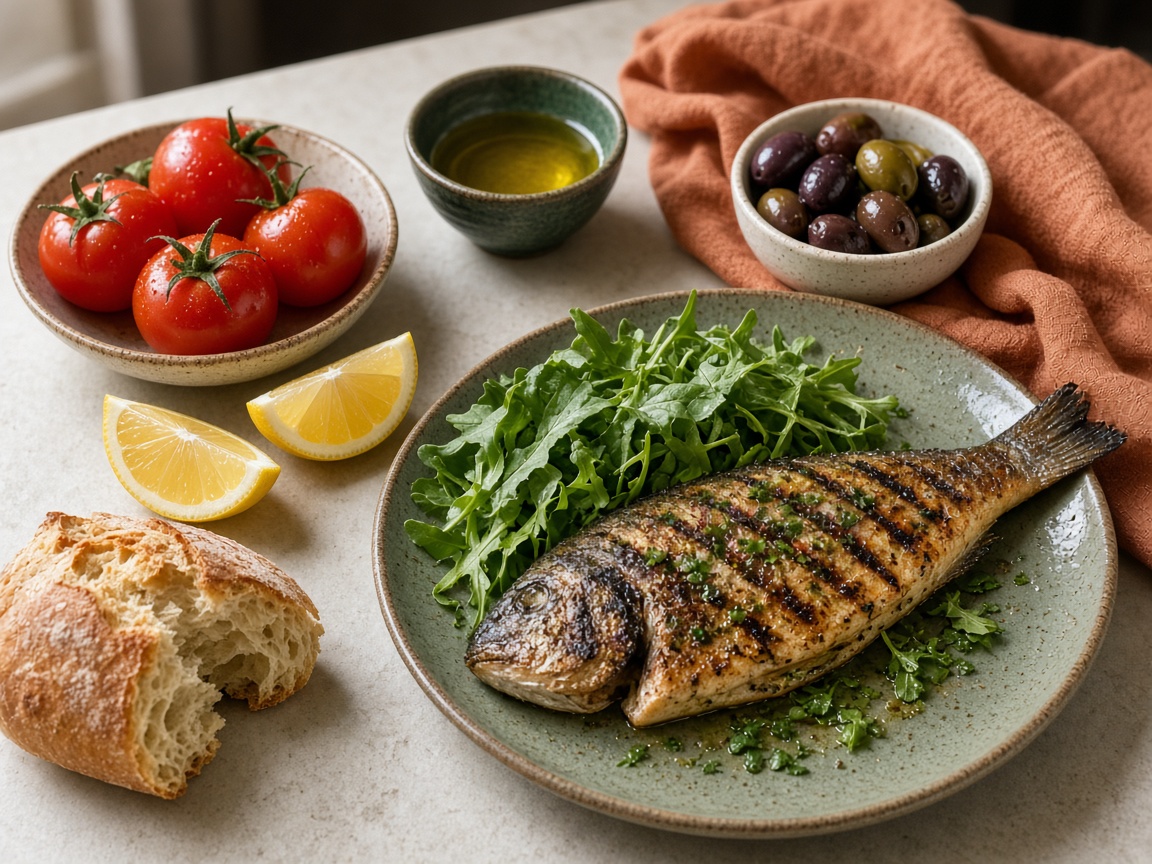
A preference for unsaturated fats and vegetables does not cancel salt in the same dish: fish cooked with a large salty sauce is still salty. The log CDC asks for, of food and drinks, is useful here as a list of salty repeats. It does not diagnose blood pressure and does not replace a talk with a clinician.
What this text draws on
- WHO Healthy diet fact sheet: energy intake in balance with expenditure; fruit and vegetables ≥400 g/day; free sugars <10% of energy (below 5% for further benefit); fat <30%; saturated fat <10%; trans fat <1%; salt <5 g/day; unsaturated fats (fish, avocado, nuts, vegetable oils) preferred to saturated and industrial trans fats.
- Dietary Guidelines for Americans, 2020–2025, and USDA MyPlate: a nutrient-dense pattern shaped by culture and budget; added sugars <10% of calories from age 2; saturated fat <10%; sodium <2,300 mg/day; half the plate fruits and vegetables; half of grains whole; varied protein foods; low-fat or fat-free dairy or fortified soy. Drinking less is better than drinking more; not drinking is an option.
- NHLBI DASH Eating Plan: vegetables, fruits, whole grains, low-fat dairy, fish, poultry, beans, nuts, vegetable oils; less fatty meat, sweets, and sugary drinks; sodium 2,300 mg or a 1,500 mg version. Studied for blood pressure, not as a crash plan and not as permission to eat everything.
- CDC, Steps for Losing Weight (January 17, 2025): a gradual pace of about 1 to 2 pounds a week is more likely to be kept than quicker loss; losing 20 pounds in 2 weeks is the example of an unrealistic goal. Modest loss, CDC’s example: 5% of 200 pounds is 10 pounds, can improve blood pressure, cholesterol, and blood sugar and could lower risk of heart disease, prediabetes, and type 2 diabetes — not a personal guarantee. Log food and drinks, activity, sleep, and stress. Goals are specific, two or three at a time; examples include water instead of a sugary drink, a 15-minute walk, a vegetable with supper. Setbacks are expected. Rewards are not food. Medicines, illness, stress, genes, hormones, environment, and age affect weight. Weight and medicine questions go to a clinician. Medicines and bariatric surgery are clinical options, not DIY.
- FDA Nutrition Facts: energy is stated per labeled serving; a package can contain several servings. A labeled serving is not always 100 g.
A short paraphrase of open guides and reviews (WHO, national recommendations, peer‑reviewed summaries). Not a quotation and not a treatment protocol.
Short answers
Is 5 g of salt the same thing as 2,300 mg of sodium?
No. Salt under 5 g a day is the WHO line. Sodium under 2,300 mg a day is the American line, and DASH also has a 1,500 mg version. This page does not treat those quantities as equal.
Can a reader simply pick 1,500 mg instead of 2,300 mg?
The article does not assign that choice. The 1,500 mg version is described in the DASH plan, which was studied for blood pressure, and treatment questions stay with a clinician.