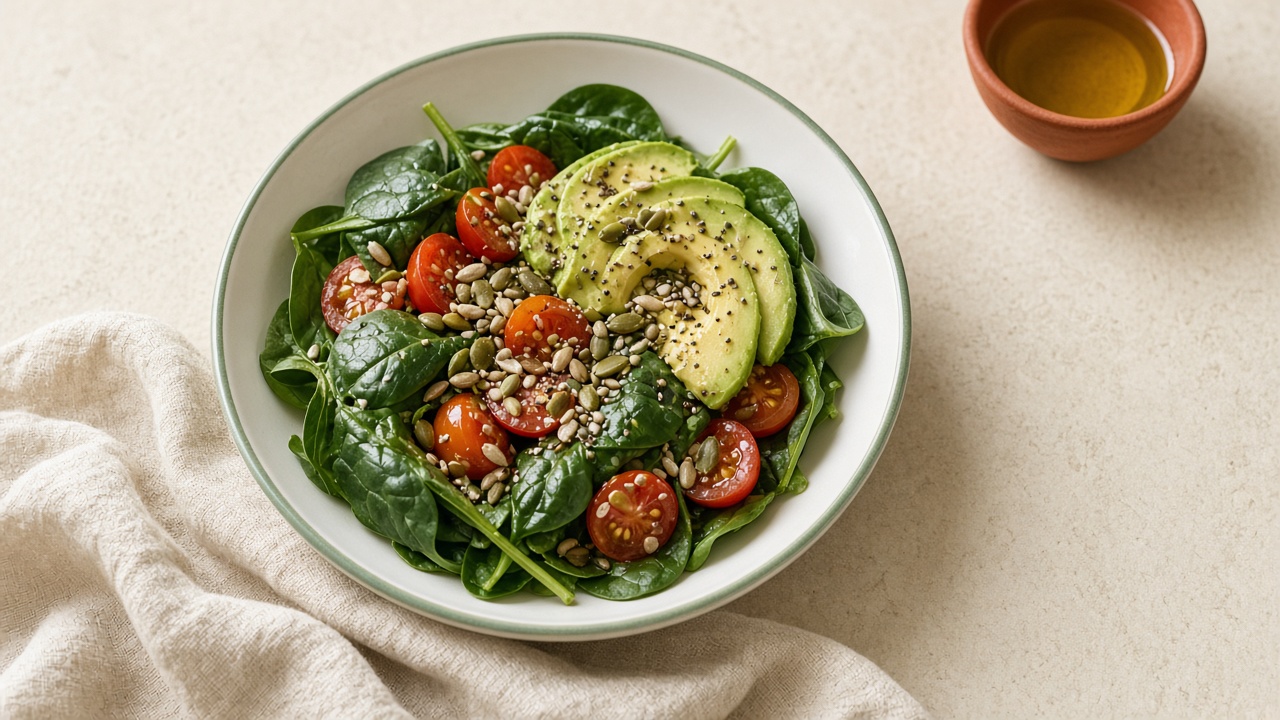
Weigh the oil
A weighed spoon of oil changes the written day more honestly than another adjustment of the activity factor. The factor does not see the pan, and the grams of oil can sit beside a guide per 100 g.

The spoon that is not counted as food
Oil often stays in memory as a way of cooking, not as a food. For the log it is still eaten mass if it was eaten with the dish. CDC includes all the food, not only what sat as a separate piece. An unnamed spoon makes the vegetables lighter on paper than they were on the plate.
WHO prefers unsaturated fats, including vegetable oils, to saturated fats and industrial trans fats. At the same time fat is kept under 30 percent of energy, saturated fat under 10 percent, and trans fat under 1 percent. Preferring the oil does not cancel accounting for it. A spoon of vegetable oil is still part of intake, not an empty space.
Weight instead of a glance
A tablespoon in different hands and different bottles is not the same mass. The sheet does not give the energy of “one spoon,” and this article will not assign it. A scale gives grams. From the grams you go to a FoodData Central guide per 100 g, remembering that brands differ.
A bottle’s label, if it has one, speaks of its own serving, and that serving is not always 100 g. Then one path is chosen, the panel or the database, and the two are not added for one spoon. Oil left in the pan and not eaten is not written down as if it had been eaten whole. The line receives what went into the food, as far as that can be separated honestly.
Why the factor has nothing to do with it
The activity factor belongs to a draft of expenditure, not to the contents of the pan. Nudging it a little higher or a little lower does not write the oil into the day. The oil is either named in grams, or it is absent from the diary. The spoon has no third condition.
Tuning the multiplier while the oil line is empty creates a feeling that the day has already been refined. What was refined was a draft that never saw the oil. The attention spent on the multiplier is better given to the scale. The scale answers a question the multiplier does not hear.
Where the spoon sits in the day
The spoon is written into the meal where it was eaten, not as “sometime in the evening.” If oil dressed a salad, that is a line on the salad or a separate line for the oil, not both full weights at once. A double count spoils the day as surely as a zero. One weight and one source for the guide keep the line readable.
A few days of that habit show how often “almost no fat” was in fact with a spoon. That is the advantage of the log: the equation is equally blind every day, while the diary can stop being blind. The activity factor does not replace that clarity. It remains a coarse draft of expenditure, and there is no drop of oil inside it.
What this text draws on
- USDA FoodData Central: guides per 100 g; brands differ. A dry-food row is not a cooked portion, because water changes the weight. Do not use a “rice triples” factor.
- WHO Healthy diet fact sheet: energy intake in balance with expenditure; fruit and vegetables ≥400 g/day; free sugars <10% of energy (below 5% for further benefit); fat <30%; saturated fat <10%; trans fat <1%; salt <5 g/day; unsaturated fats (fish, avocado, nuts, vegetable oils) preferred to saturated and industrial trans fats.
- CDC, Steps for Losing Weight (January 17, 2025): a gradual pace of about 1 to 2 pounds a week is more likely to be kept than quicker loss; losing 20 pounds in 2 weeks is the example of an unrealistic goal. Modest loss, CDC’s example: 5% of 200 pounds is 10 pounds, can improve blood pressure, cholesterol, and blood sugar and could lower risk of heart disease, prediabetes, and type 2 diabetes — not a personal guarantee. Log food and drinks, activity, sleep, and stress. Goals are specific, two or three at a time; examples include water instead of a sugary drink, a 15-minute walk, a vegetable with supper. Setbacks are expected. Rewards are not food. Medicines, illness, stress, genes, hormones, environment, and age affect weight. Weight and medicine questions go to a clinician. Medicines and bariatric surgery are clinical options, not DIY.
A short paraphrase of open guides and reviews (WHO, national recommendations, peer‑reviewed summaries). Not a quotation and not a treatment protocol.
Short answers
Is a small tweak of the activity factor enough if the oil was not weighed?
No. The factor does not see the pan. The spoon changes the written day only when it is entered by weight.
Does the sheet give the energy of one spoon of oil?
No. There is a guide per 100 g, and a note that brands differ. This article does not assign a ready-made price for a spoon.