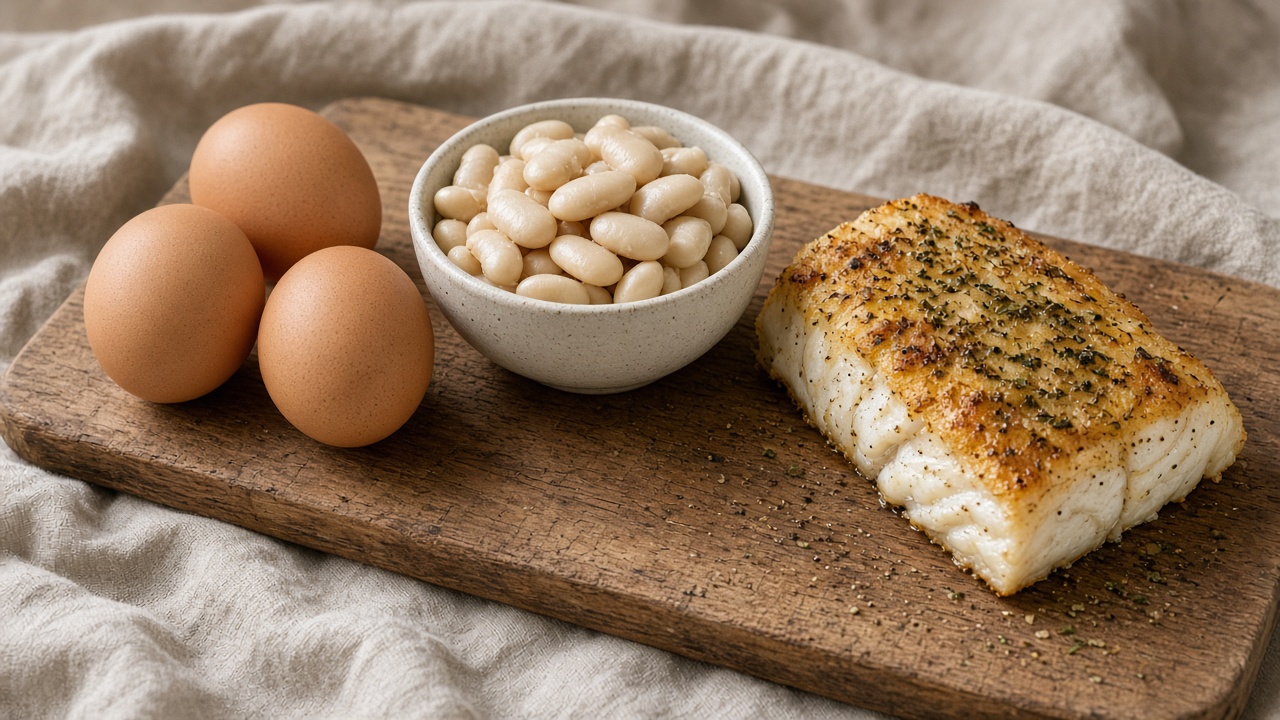
Beans as the protein
Beans, peas, and lentils belong to the MyPlate protein foods and at the same time help the fiber adults need at not less than 25 g a day from food. For a budget and for one's own cooking this is often a calmer pot than an expensive cut, and the vegetable half stays.

Two jobs for one handful
On the protein-food list, beans stand beside fish, meat, poultry, eggs, nuts, and soy. The same handful helps the fiber line, because the WHO guideline takes 25 g from food, not from an empty part of the plate. One spoon does not have to finish both lines before the day ends. It takes an honest place in two conversations at once, if it was eaten and not only cooked.
The vegetable half is not cancelled by that. Beans are not cabbage and do not collect the 400 g of fruit and vegetables in their place. A stew in which beans and vegetables sit together shows both shares in one bowl. A stew of beans alone, without a vegetable, covers the protein part better than it covers half the plate; a vegetable or a fruit is still needed beside it.
A guide without a new quota
The safe protein level for adults is 0.83 g per kg of body weight per day. It is a population guide, not an assignment for how many bowls of beans, and not a muscle-gain plan. The article adds no second protein figure and does not translate 0.83 g/kg into spoons. Kidney disease changes the level through a clinician, and beans do not make that decision by themselves.
The variety of the list remains, even if beans are cheap and convenient. A week of only one can is already narrower than the MyPlate list. Fish, an egg, or yogurt on other days does not cancel the beans. It returns the list to the word varied; the FAO/WHO/UNU report does not name a powder as mandatory in place of the pot.
The budget and one's own pot
The American guidelines include culture and budget outright in a nutrient-dense pattern. Dry lentils, seasonal cabbage, and a vegetable oil build a plate without a restaurant price. This is not a separate "poverty diet. " It is the same drawing: half fruit and vegetables, a protein food, and whole grain where it can be managed; an expensive ingredient is not an entry ticket.
Salt in a ready can and in the sauce on the beans belongs to the limit of less than 5 g of salt a day, even if the pot looks homemade. Sodium under 2,300 mg stays another line, and the article does not equate grams of salt with milligrams of sodium. Fat in the dressing stays fat under 30% of energy. The phrase plant protein does not erase those shares.
What plants do not contain
If animal food is scarce or absent, one pot of beans is not enough for vitamin B12. NIH says it outright: plants do not contain B12, and a reliable source is needed, a fortified food or a supplement. This article does not prescribe a dose. Fortified soy, which already stands in the MyPlate dairy group, can be such a food, but the choice of source stays with the person and, in illness, with a clinician.
Fiber, the protein part, and B12 are three different conversations. Beans help the first two. They do not close the third, and that is not a failure of the pot. It is a property of plants; a log of the day shows whether an animal food or a fortified food was there at all; a picture of one plate of lentils does not settle that question for the week.
What this text draws on
- Dietary Guidelines for Americans, 2020–2025, and USDA MyPlate: a nutrient-dense pattern shaped by culture and budget; added sugars <10% of calories from age 2; saturated fat <10%; sodium <2,300 mg/day; half the plate fruits and vegetables; half of grains whole; varied protein foods; low-fat or fat-free dairy or fortified soy. Drinking less is better than drinking more; not drinking is an option.
- WHO carbohydrate guideline, 2023: at least 25 g of fiber a day for adults, from food.
- FAO/WHO/UNU, 2007: the safe protein level for adults is 0.83 g per kg body weight per day. A population figure, not a muscle-gain plan. Kidney disease changes it through a clinician.
- NIH Office of Dietary Supplements, vitamin B12: people who eat little or no animal food need a reliable B12 source, a fortified food or a supplement. Plants do not contain B12. This article does not prescribe a dose.
- WHO Healthy diet fact sheet: energy intake in balance with expenditure; fruit and vegetables ≥400 g/day; free sugars <10% of energy (below 5% for further benefit); fat <30%; saturated fat <10%; trans fat <1%; salt <5 g/day; unsaturated fats (fish, avocado, nuts, vegetable oils) preferred to saturated and industrial trans fats.
A short paraphrase of open guides and reviews (WHO, national recommendations, peer‑reviewed summaries). Not a quotation and not a treatment protocol.
Short answers
Do beans replace both meat and vegetables?
They take the place of a protein food and help fiber. They do not replace the vegetable half or the 400 g of fruit and vegetables.
Where does B12 come from if all the protein is beans?
Plants do not contain B12. With little animal food a fortified food or a supplement is needed. This article does not prescribe a dose.