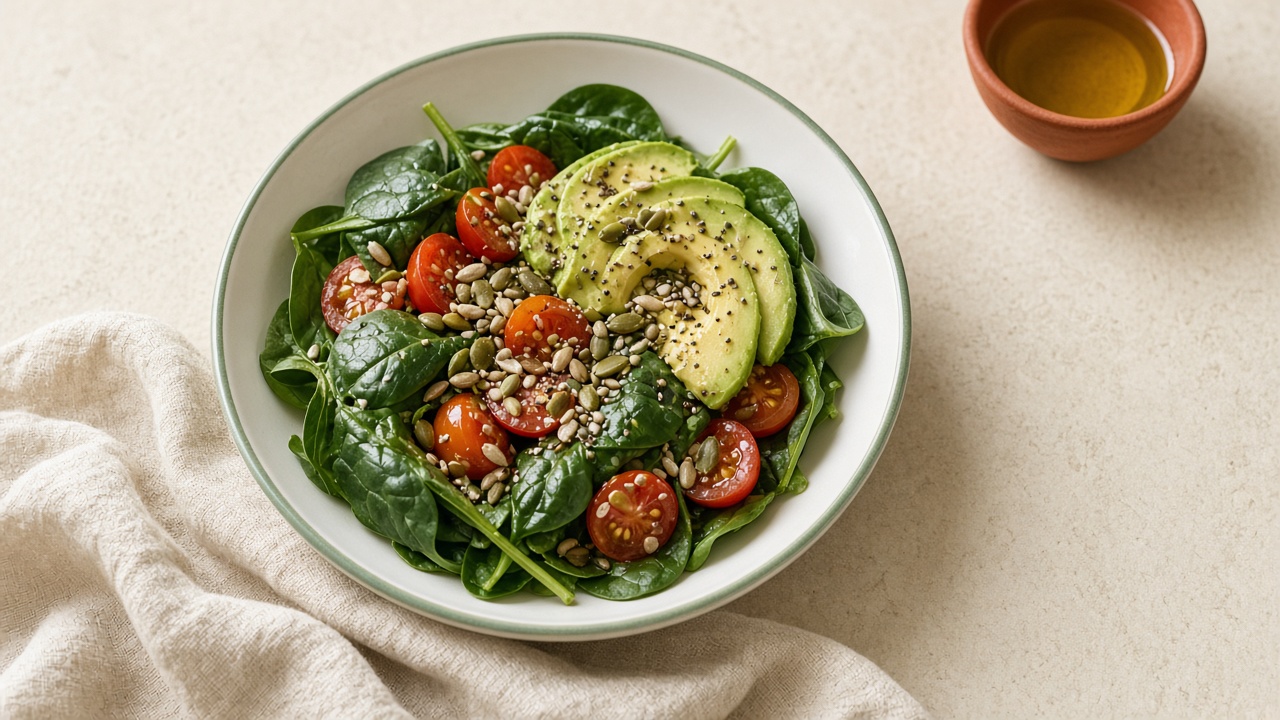
A spoon on the vegetables
A spoon of oil on vegetables is real food: WHO prefers the unsaturated fats of fish, avocado, nuts, and vegetable oils to saturated and industrial trans fats. The same spoon still belongs to the fat share the fact sheet keeps under 30% of energy.
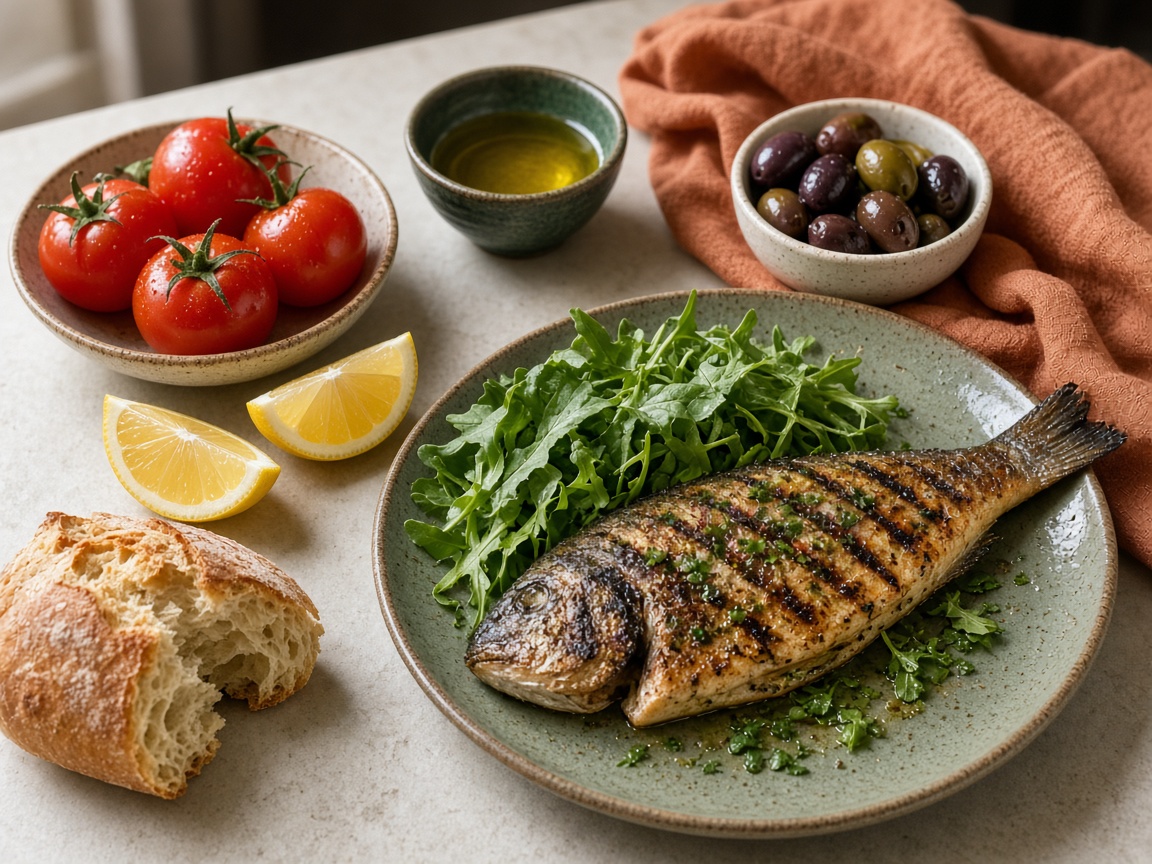
What replaces saturated fat
The fact sheet does not demand zero fat and does not declare vegetable oil invisible. It asks for unsaturated sources to be preferred: fish, avocado, nuts, vegetable oils. They replace the saturated fat of fatty meat, butter, and cream, rather than landing as a second layer that nobody counts. A spoon on the vegetables can be that replacement, if it takes the place of another fat instead of sitting on top of it.
A vegetable under oil remains a vegetable and still helps the half plate and the day's 400 g. The oil does not take that help away, and it is not itself written down as a vegetable. One lunch has two lines: the vegetable in its share, the spoon in the fat share. Folding them into one "light plate" means ceasing to see the spoon.
The spoon is part of energy
WHO keeps energy intake in balance with expenditure. A spoon of oil is part of intake, even when it shines on a salad instead of sitting as a separate piece. The phrase "but it is on vegetables" does not zero the balance. Two spoons are already a different portion of fat, even though the plate still looks like a salad.
The share of total fat is under 30% of the day's energy, not under 30% of one plate at any cost, and not permission to collect spoons while the vegetable stays green. Saturated fat inside that picture stays under 10%. If the spoon is actually lard or ghee, the preference for unsaturated fat is already missed, even though the vegetable under it is the same. The kind of fat and its place in energy are looked at together.
Trans fat and the fryer
WHO keeps industrial trans fat under 1% of energy and links it with partially hydrogenated fats in fried and packaged foods. A vegetable that is boiled or baked and then dressed with vegetable oil is closer to that text than the same vegetable from a deep fryer. "Healthy fat need not be limited" does not follow from the fact sheet. The limit stays; the source changes.
Salt on fried vegetables does not hide inside the conversation about fat. The salt limit is less than 5 g a day. Sodium under 2,300 mg in the American guidelines is not translated by this article into grams of salt: the units differ and the texts differ. A spoon of oil and a pinch of salt are two additions, and each is called by its own name.
The oil trial is not about weight
PREDIMED looked at adults whose cardiovascular risk was already high. A Mediterranean pattern with extra-virgin olive oil or with nuts was compared with advice to eat less fat. The Mediterranean groups had fewer major cardiovascular events. It is not a weight-loss trial, and a spoon on the vegetables does not become a weight-loss method taken from it.
The 2013 paper was retracted and republished in 2018 because of randomization problems, and the republication kept the finding of fewer events. A percent and a hazard ratio are not given here. The trial does not permit eating everything and does not cancel the fat share under 30% of energy. It speaks about events in people who already had high risk, not about oil on a salad losing weight by itself.
What this text draws on
- WHO Healthy diet fact sheet: energy intake in balance with expenditure; fruit and vegetables ≥400 g/day; free sugars <10% of energy (below 5% for further benefit); fat <30%; saturated fat <10%; trans fat <1%; salt <5 g/day; unsaturated fats (fish, avocado, nuts, vegetable oils) preferred to saturated and industrial trans fats.
- Dietary Guidelines for Americans, 2020–2025, and USDA MyPlate: a nutrient-dense pattern shaped by culture and budget; added sugars <10% of calories from age 2; saturated fat <10%; sodium <2,300 mg/day; half the plate fruits and vegetables; half of grains whole; varied protein foods; low-fat or fat-free dairy or fortified soy. Drinking less is better than drinking more; not drinking is an option.
- PREDIMED, Estruch et al., NEJM: adults who already had high cardiovascular risk. A Mediterranean pattern with extra-virgin olive oil or with nuts was compared with advice to eat less fat. The Mediterranean groups had fewer major cardiovascular events. The 2013 paper was retracted and republished in 2018 because of randomization problems; the republication kept the finding of fewer events. Not a weight-loss trial. Do not give a percent or a hazard ratio.
A short paraphrase of open guides and reviews (WHO, national recommendations, peer‑reviewed summaries). Not a quotation and not a treatment protocol.
Short answers
Can oil on a salad go uncounted if it is a vegetable oil?
No. Unsaturated oil is preferable to saturated fat, but the spoon still belongs to fat under 30% of energy and to the balance of intake with expenditure.
Does PREDIMED mean olive oil causes weight loss?
No. It compared a pattern in adults who already had high cardiovascular risk. It was not a weight-loss trial. This article gives no percent and no hazard ratio.