Food in hypertension without self-treatment
The DASH plan and the salt limits are background for a food conversation in hypertension, not self-treatment and not a reason to edit medicines. The trials speak about a dietary pattern, blood pressure, or events, and the prescription stays with the clinician.
Which plan sits as background
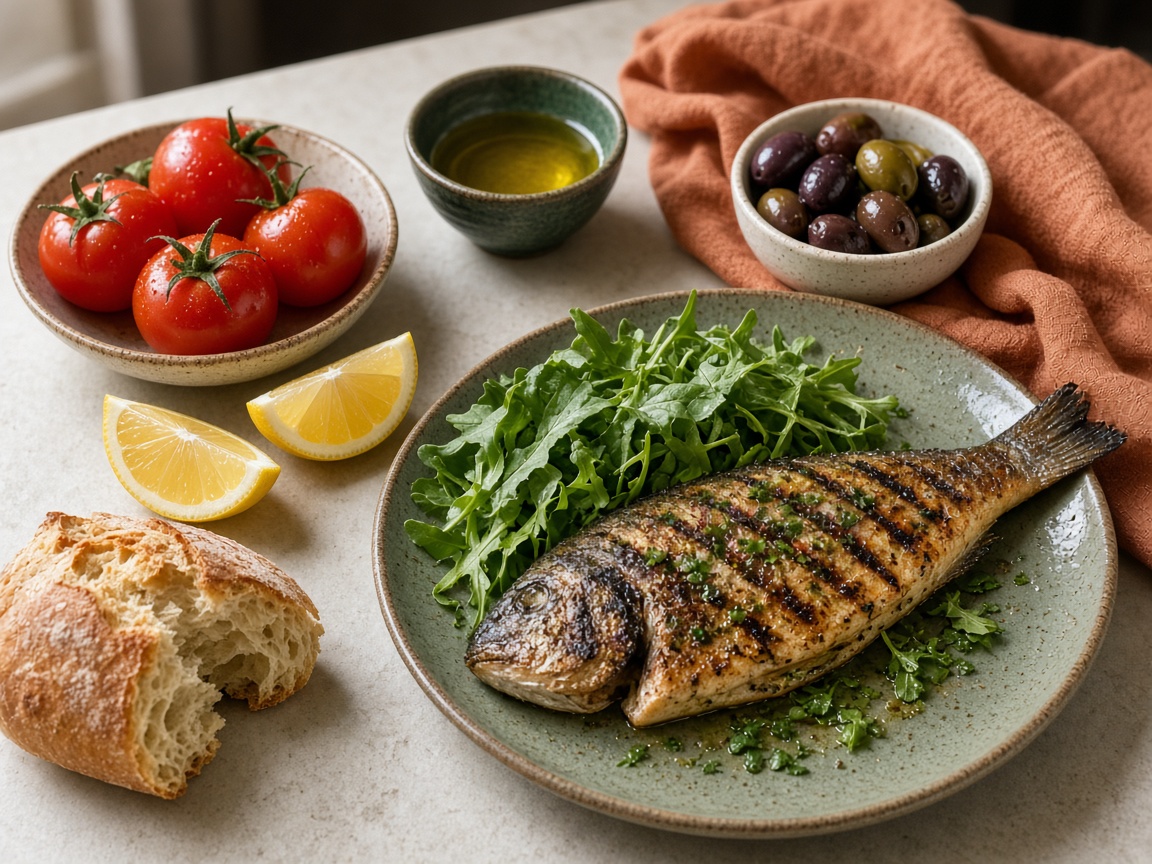
DASH, as NHLBI describes it, is vegetables, fruits, whole grains, low-fat dairy, fish, poultry, beans, nuts, and vegetable oils, and less fatty meat, sweets, and sugary drinks. Sodium in the plan is 2,300 mg or a 1,500 mg version. The plan was studied for blood pressure, it is not a crash plan, and it is not permission to eat everything.
WHO keeps salt under 5 g a day inside wider lines: energy balance, fruit and vegetables of at least 400 g, free sugars under 10%, fat under 30%, saturated fat under 10%, trans fat under 1%, and a preference for unsaturated fats. The article lays those lines down as background and does not assign one of the sodium figures as a personal dose. If a clinician has already named a salt limit, it outranks a general paragraph.
A trial without millimeters
The DASH trial, Appel and colleagues, NEJM, 1997, compared a pattern higher in vegetables, fruit, and low-fat dairy and lower in saturated fat with a typical American control diet. Blood pressure fell on that pattern. The page does not give millimeters of mercury.
The direction of the finding is downward, and it is not a promise to a named reader. The finding is not a reason to drop a medicine because the pattern “ought to be enough”. The trial was not an invitation to self-treatment.
Another trial is about events, not about stopping a drug
PREDIMED, Estruch and colleagues, NEJM, looked at adults who already had high cardiovascular risk. A Mediterranean pattern with extra-virgin olive oil or with nuts was compared with advice to eat less fat, and the Mediterranean groups had fewer major cardiovascular events. The 2013 paper was retracted and republished in 2018 because of randomization problems, and the republication kept the finding of fewer events.
It is not a weight-loss trial, and the page gives neither a percent nor a hazard ratio. Fewer events in a high-risk group is not permission to change a hypertension medicine from an article. The oil and the nuts in that trial do not replace a prescription.
The tablet stays a tablet
CDC notes that medicines affect weight, that weight and medicine questions go to a clinician, and that medicines and bariatric surgery are clinical options, not DIY. A blood-pressure medicine sits inside that boundary even when the food pattern is real. It is not skipped, split, or swapped because salt went down or because a trial reported fewer events.
The plate can be discussed at the visit, and it does not lead the visit. Modest loss in the CDC example can improve blood pressure and is not a personal guarantee and not a substitute for the drug. There is no dose in the article.
What this text draws on
- NHLBI DASH Eating Plan: vegetables, fruits, whole grains, low-fat dairy, fish, poultry, beans, nuts, vegetable oils; less fatty meat, sweets, and sugary drinks; sodium 2,300 mg or a 1,500 mg version. Studied for blood pressure, not as a crash plan and not as permission to eat everything.
- DASH, Appel et al., NEJM 1997: a pattern higher in vegetables, fruit, and low-fat dairy and lower in saturated fat lowered blood pressure compared with a typical American control diet. Do not give millimeters of mercury.
- WHO Healthy diet fact sheet: energy intake in balance with expenditure; fruit and vegetables ≥400 g/day; free sugars <10% of energy (below 5% for further benefit); fat <30%; saturated fat <10%; trans fat <1%; salt <5 g/day; unsaturated fats (fish, avocado, nuts, vegetable oils) preferred to saturated and industrial trans fats.
- PREDIMED, Estruch et al., NEJM: adults who already had high cardiovascular risk. A Mediterranean pattern with extra-virgin olive oil or with nuts was compared with advice to eat less fat. The Mediterranean groups had fewer major cardiovascular events. The 2013 paper was retracted and republished in 2018 because of randomization problems; the republication kept the finding of fewer events. Not a weight-loss trial. Do not give a percent or a hazard ratio.
- CDC, Steps for Losing Weight (January 17, 2025): a gradual pace of about 1 to 2 pounds a week is more likely to be kept than quicker loss; losing 20 pounds in 2 weeks is the example of an unrealistic goal. Modest loss, CDC’s example: 5% of 200 pounds is 10 pounds, can improve blood pressure, cholesterol, and blood sugar and could lower risk of heart disease, prediabetes, and type 2 diabetes — not a personal guarantee. Log food and drinks, activity, sleep, and stress. Goals are specific, two or three at a time; examples include water instead of a sugary drink, a 15-minute walk, a vegetable with supper. Setbacks are expected. Rewards are not food. Medicines, illness, stress, genes, hormones, environment, and age affect weight. Weight and medicine questions go to a clinician. Medicines and bariatric surgery are clinical options, not DIY.
A short paraphrase of open guides and reviews (WHO, national recommendations, peer‑reviewed summaries). Not a quotation and not a treatment protocol.
Short answers
Does DASH replace a blood-pressure medicine?
No: the DASH plan was studied for blood pressure, and it is dietary background, not self-treatment. The medicine stays with a clinician, and the article does not give millimeters of mercury.
Which sodium figure should a person assign to themselves?
The page does not assign one: the DASH description has a 2,300 mg version and a 1,500 mg version, and WHO keeps salt under 5 g a day. A personal limit, if one is needed, is set by a clinician.