A joint
Pain in a joint stops the session rather than serving as a reason to finish the set. The plate lines on vegetables, fat, and salt do not require a squat and do not become a treatment for the joint.

Pain ends the session
Both WHO and CDC include muscle-strengthening on two or more days in the adult activity line. That line does not outrank pain: if a joint hurts during the session, the session stops. The article does not teach pushing through, does not give a scale for “working inside the pain,” and does not name a number of repetitions that are still allowed.
Those rules would already be a routine, and a harmful one. Finishing a set for the sake of checking off a strength day is not required. A stopped session does not have to be repaid in the evening with the same movement.
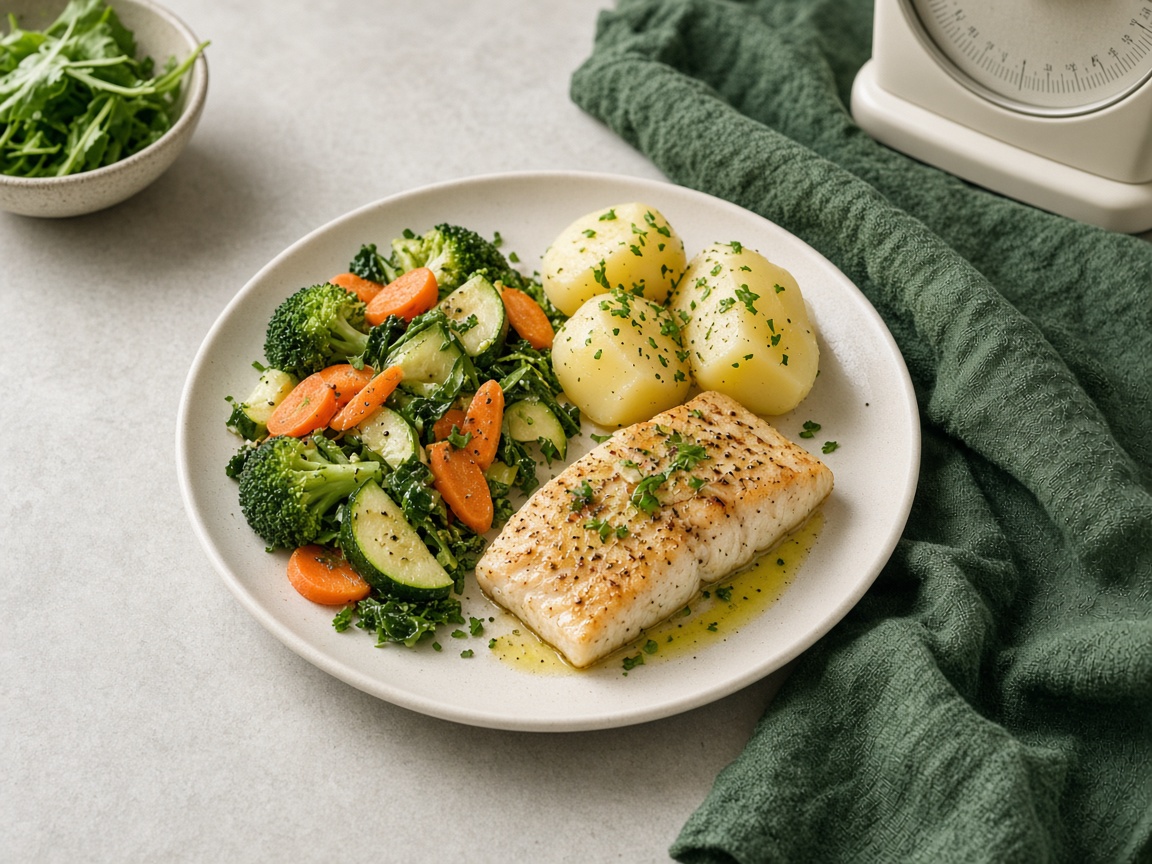
A squat is not hidden in the plate
WHO talks about fruit and vegetables of at least 400 g a day, fat under 30% of energy, saturated fat under 10%, trans fat under 1%, and salt under 5 g. Unsaturated fats, fish, avocado, nuts, and vegetable oils are preferred to saturated and industrial trans fats. None of those sentences names an exercise.
Fiber, at least 25 g a day from food, is about food as well, not about a squat. A person can keep that plate and never squat. The plate is not a contract that demands a gym.
A strength day does not cancel the stop
The strength line remains a population line. It is not an order to load a painful joint, and it is not a list of swaps the article will declare safe. How to train around a joint, whether to train, and when to return are questions for a clinician.
“Some activity is better than none” allows a day with no session if pain has already stopped the one that was planned. Sedentary time should be limited, but not at the price of pain in a joint. Someone else’s exercise “instead” does not become safe because it was called a substitute.
Fat and salt are not a joint plan
It is easy to turn a sentence about fat quality into an “anti-inflammatory plate” and call it treatment. The sources do not do that: they talk about diet quality, not about healing a joint. There is no promise in the text that a vegetable oil replaces care.
The article gives no supplement dose and no food dose “for cartilage”. If the problem is pain, swelling, or loss of function, the address is a clinician. The plate can remain a plate and not pretend to be a plan for the joint.
What this text draws on
- WHO Physical activity fact sheet: adults 18–64 at least 150–300 minutes of moderate aerobic activity a week, or 75–150 minutes vigorous, plus muscle-strengthening on 2 or more days; some activity is better than none; sedentary time should be limited. From age 65, the same plus balance and coordination on 3 or more days.
- CDC, Adult Activity: at least 150 minutes of moderate aerobic activity a week and muscle-strengthening on 2 or more days.
- WHO Healthy diet fact sheet: energy intake in balance with expenditure; fruit and vegetables ≥400 g/day; free sugars <10% of energy (below 5% for further benefit); fat <30%; saturated fat <10%; trans fat <1%; salt <5 g/day; unsaturated fats (fish, avocado, nuts, vegetable oils) preferred to saturated and industrial trans fats.
- WHO carbohydrate guideline, 2023: at least 25 g of fiber a day for adults, from food.
A short paraphrase of open guides and reviews (WHO, national recommendations, peer‑reviewed summaries). Not a quotation and not a treatment protocol.
Short answers
Does the plate require a squat in order to work?
No: vegetables, fat, salt, and fiber in the guidelines do not require a squat. Those lines do not name an exercise at all.
Is joint pain a reason to finish the set?
No: pain stops the session. Strength work on two or more days is a general adult line, and it does not cancel the stop.