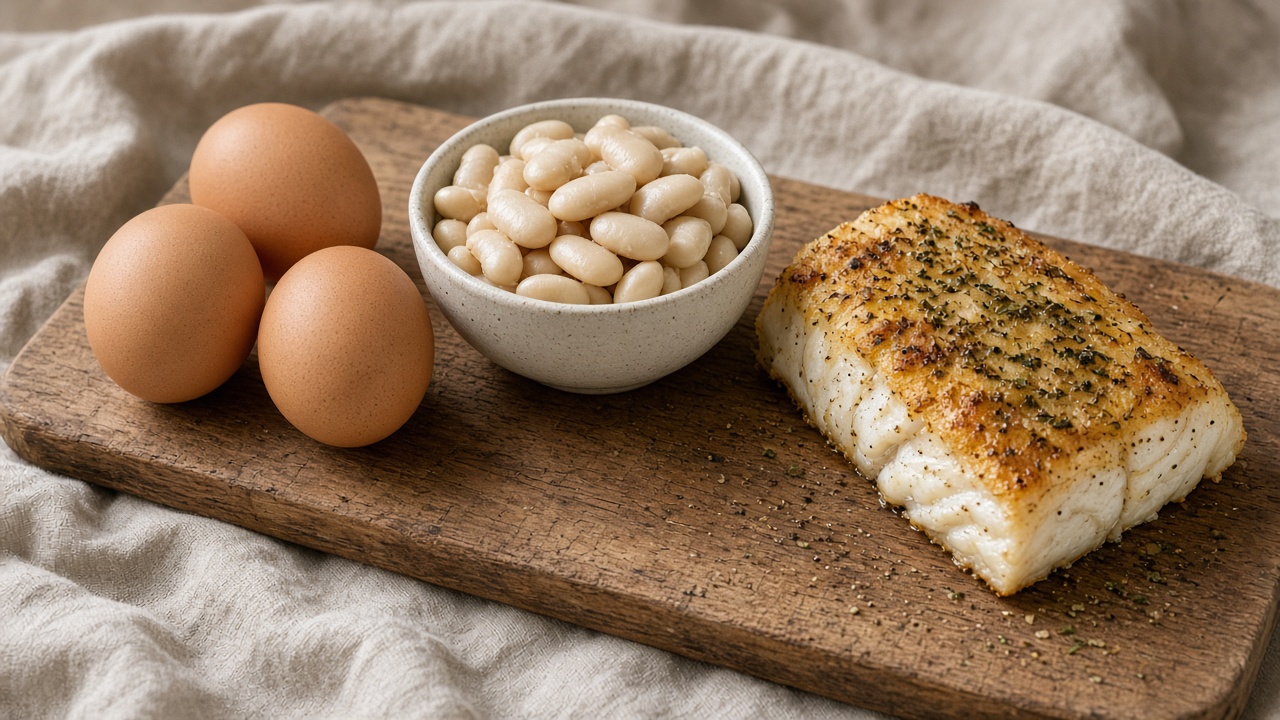
Eggs
Eggs sit on the MyPlate list of protein foods beside fish, meat, poultry, beans, nuts, and soy. They do not replace vegetables, grain, and the limits on fat, sugar, and salt, and they do not become a pattern by themselves.

Where an egg sits on the picture of the plate
The Dietary Guidelines keep protein foods varied, not collapsed into one name. An egg is one of those foods, handy at breakfast or in a salad, and it covers the protein place of the meal in which it was eaten. Half the plate is still fruits and vegetables, half of grains are whole, and dairy is its own group.
The safe protein level for adults is 0.83 g per kg of body weight per day. An egg can be part of a day that moves toward that guide. This article does not turn one egg into a fraction of the daily figure: the FAO, WHO, and UNU report contains no such conversion. The guide stays daily and population-wide, not a quota of eggs.
What an egg does not cover
The line of at least 400 g of fruit and vegetables is not gathered by an egg. Fiber of at least 25 g a day for adults also comes from food that includes vegetables, fruit, whole grain, and beans, not the yolk. A breakfast of eggs alone leaves those lines to the other meals, and they are not counted as already done.
Free sugars, salt, and fat around the egg live their own life. Bacon, cheese, butter, and a sugary drink beside it do not enter the egg's credit. Saturated fat stays under 10% of energy, total fat under 30%, salt under 5 g, added sugars under 10% of calories. A fry-up with that set can leave the shares, even though a protein food was in it.
Eggs and days with little other animal food
Plants do not contain vitamin B12. If animal food is scarce or absent, a reliable source is needed: a fortified food or a supplement, and this article does not prescribe a dose. An egg is animal food, so it is not that empty plant line, but one food is still not described as a complete pattern.
A day of only eggs and tea does not become sufficient because plants lack B12. Vegetables, grain, and the fat limits remain. If there is no animal food at all, an egg is exactly a case where the source is no longer a plant, and a supplement question is not decided by this page. Kidney disease still changes the protein guide through a clinician, regardless of an egg at breakfast.
How to log an egg without inflating it
A log needs a name and an amount: one egg, two eggs, an egg in a salad. That is the protein food of that meal, not a judgment of the whole day. It helps to see a vegetable or a fruit and a grain beside it, otherwise the line looks like a pattern when it is one item on a list.
A photo draft is not grams until the person confirms the meal and the day. The label of a ready dish with egg, if there is one, shows energy per labeled serving, and a package can contain several servings. A labeled serving is not always 100 g. A home egg without a label is logged as the egg that was eaten, not as a row from someone else's table on a dry weight.
What this text draws on
- Dietary Guidelines for Americans, 2020–2025, and USDA MyPlate: a nutrient-dense pattern shaped by culture and budget; added sugars <10% of calories from age 2; saturated fat <10%; sodium <2,300 mg/day; half the plate fruits and vegetables; half of grains whole; varied protein foods; low-fat or fat-free dairy or fortified soy. Drinking less is better than drinking more; not drinking is an option.
- FAO/WHO/UNU, 2007: the safe protein level for adults is 0.83 g per kg body weight per day. A population figure, not a muscle-gain plan. Kidney disease changes it through a clinician.
- WHO Healthy diet fact sheet: energy intake in balance with expenditure; fruit and vegetables ≥400 g/day; free sugars <10% of energy (below 5% for further benefit); fat <30%; saturated fat <10%; trans fat <1%; salt <5 g/day; unsaturated fats (fish, avocado, nuts, vegetable oils) preferred to saturated and industrial trans fats.
- WHO carbohydrate guideline, 2023: at least 25 g of fiber a day for adults, from food.
- NIH Office of Dietary Supplements, vitamin B12: people who eat little or no animal food need a reliable B12 source, a fortified food or a supplement. Plants do not contain B12. This article does not prescribe a dose.
- FDA Nutrition Facts: energy is stated per labeled serving; a package can contain several servings. A labeled serving is not always 100 g.
A short paraphrase of open guides and reviews (WHO, national recommendations, peer‑reviewed summaries). Not a quotation and not a treatment protocol.
Short answers
Can eggs be the whole food of the day?
No. They are one protein food on the list. Fruit and vegetables, grain, fiber, and the fat and salt limits remain separate lines.
Does each egg need to be counted as a fraction of 0.83 g per kg?
No. This article does not turn an egg into a fraction of the daily guide. The guide is for the day, and an egg is simply the protein food of the meal where it was eaten.