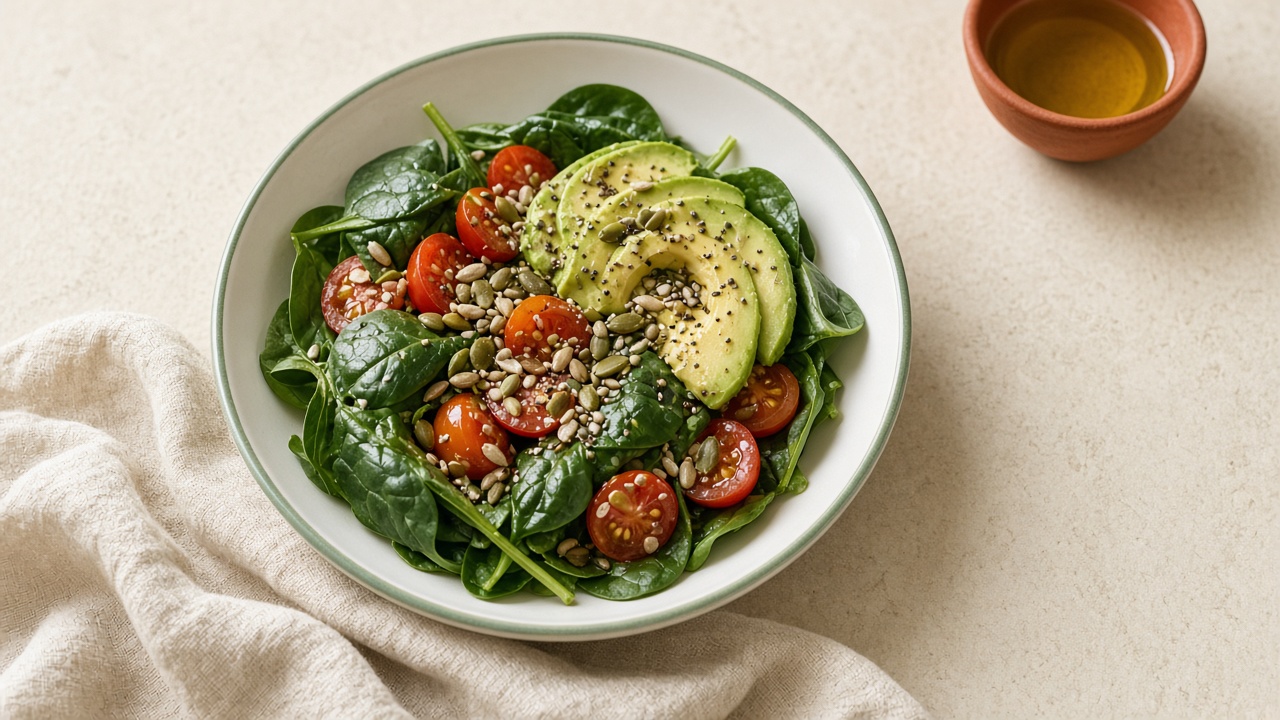
A handsome plate, a flat scale
A handsome plate and a scale that does not move are a reason to read the oil, the drinks, the weekends, and several mornings, not a reason to change the theory at once. CDC asks for a log of food and drinks, activity, sleep, and stress, because weight is not explained by one successful lunch alone.

Oil, drinks, and weekends first
A frame of the vegetable half can repeat at every weekday lunch, while evening oil, a sweet glass, and Saturday stay outside the log. WHO keeps energy in balance with expenditure, and those unseen pieces belong to intake no less than the salad in the frame. A spoon on the vegetables is preferable when it is unsaturated, and it is still energy. A drink spends free sugars under 10% of energy, even when the plate follows MyPlate.
Several mornings in a row are needed because one successful dawn does not describe the week. Breakfast may be absent without breaking a law: these texts have no mandatory morning slot. But if the mornings exist and they differ each time, one photograph will not replace them. CDC calls setbacks expected; looking for a new scheme before the oil, the drinks, and the weekends have been read means changing the theory ahead of the log.
Weight is not explained by one plate
Medicines, illness, stress, genes, hormones, environment, and age affect weight. A handsome plate does not stand in that list as the only cause if the scale is still. Questions about weight and about medicines go to a clinician. Medicines and bariatric surgery are clinical options, not a do-it-yourself project and not the next chapter of a kitchen theory; a log of food, drinks, activity, sleep, and stress is material for a clear picture, not a substitute for a clinical conversation.
Modest loss in the CDC example — 5% of 200 pounds, which is 10 pounds — can improve blood pressure, cholesterol, and blood sugar and could lower the risk of heart disease, prediabetes, and type 2 diabetes. That is not a personal guarantee and not a promise that this plate will produce that result. A waist above 102 cm in men and above 88 cm in women is linked with higher risk and is not a diagnosis. The scale and the tape do not argue with the plate; they are about something else.
The pace in the CDC steps
CDC treats a gradual pace of about 1 to 2 pounds a week as more likely to be kept than quick loss. Losing 20 pounds in 2 weeks is given as the example of an unrealistic goal. A still scale against handsome lunches is not an invitation to start that race. This article does not assign a personal deficit and does not teach cutting a week by guesswork; it returns to the log of oil, drinks, and weekends.
Floors of 1,500 kcal in the male profile and 1,200 kcal in the female profile in ScanDish are product settings, not a WHO table and not the CDC steps. The activity steps 1.2, 1.375, 1.55, and 1.725 are product settings too. They do not explain why the scale is still, and they do not replace the question of what was eaten. Adults are still named at least 150 minutes of moderate activity a week and muscle-strengthening on two or more days; activity is logged, not subtracted from a photograph of the plate.
A week of drafts
In ScanDish a number from a photo stays a draft until the person confirms the meal and the day. A week of handsome drafts is not a week of grams. Confirming does not turn an estimate into a laboratory scale and does not prove that the oil and the drink were what the picture suggests, if they were never named. The day is built from confirmed lines, not from the best frames.
Goals stay specific and short, two or three at a time: water instead of a sugary drink, a vegetable with supper, a fifteen-minute walk. Rewards are not food. If after such a log the weight is still not moving as hoped, a conversation with a clinician is more fitting than a new theory of plates. The handsome lunch can stay; it cannot stay the only explanation of a scale that does not move.
What this text draws on
- CDC, Steps for Losing Weight (January 17, 2025): a gradual pace of about 1 to 2 pounds a week is more likely to be kept than quicker loss; losing 20 pounds in 2 weeks is the example of an unrealistic goal. Modest loss, CDC’s example: 5% of 200 pounds is 10 pounds, can improve blood pressure, cholesterol, and blood sugar and could lower risk of heart disease, prediabetes, and type 2 diabetes — not a personal guarantee. Log food and drinks, activity, sleep, and stress. Goals are specific, two or three at a time; examples include water instead of a sugary drink, a 15-minute walk, a vegetable with supper. Setbacks are expected. Rewards are not food. Medicines, illness, stress, genes, hormones, environment, and age affect weight. Weight and medicine questions go to a clinician. Medicines and bariatric surgery are clinical options, not DIY.
- WHO Healthy diet fact sheet: energy intake in balance with expenditure; fruit and vegetables ≥400 g/day; free sugars <10% of energy (below 5% for further benefit); fat <30%; saturated fat <10%; trans fat <1%; salt <5 g/day; unsaturated fats (fish, avocado, nuts, vegetable oils) preferred to saturated and industrial trans fats.
- CDC, Adult Activity: at least 150 minutes of moderate aerobic activity a week and muscle-strengthening on 2 or more days.
- NHLBI waist assessment: above 102 cm (40 inches) in men and above 88 cm (35 inches) in women is linked with higher risk. Not a diagnosis.
A short paraphrase of open guides and reviews (WHO, national recommendations, peer‑reviewed summaries). Not a quotation and not a treatment protocol.
Short answers
If the plate is handsome every day and the scale is flat, is the theory already wrong?
Look first at oil, drinks, weekends, and several mornings, plus activity, sleep, and stress. Medicines, illness, genes, hormones, environment, and age also affect weight, and that is a question for a clinician, not for a new scheme by guesswork.
Do handsome photos across a week already prove energy balance?
No. In ScanDish a photo stays a draft until the meal and the day are confirmed. A week of frames without the oil and the drink named is not a week of what was eaten.