
Fish instead of sausage
Fish and sausage can occupy the same place as a protein food on the plate, but not the same place for saturated fat and salt. WHO prefers fish among unsaturated fats, while sausage readily spends both salt and saturated fat.
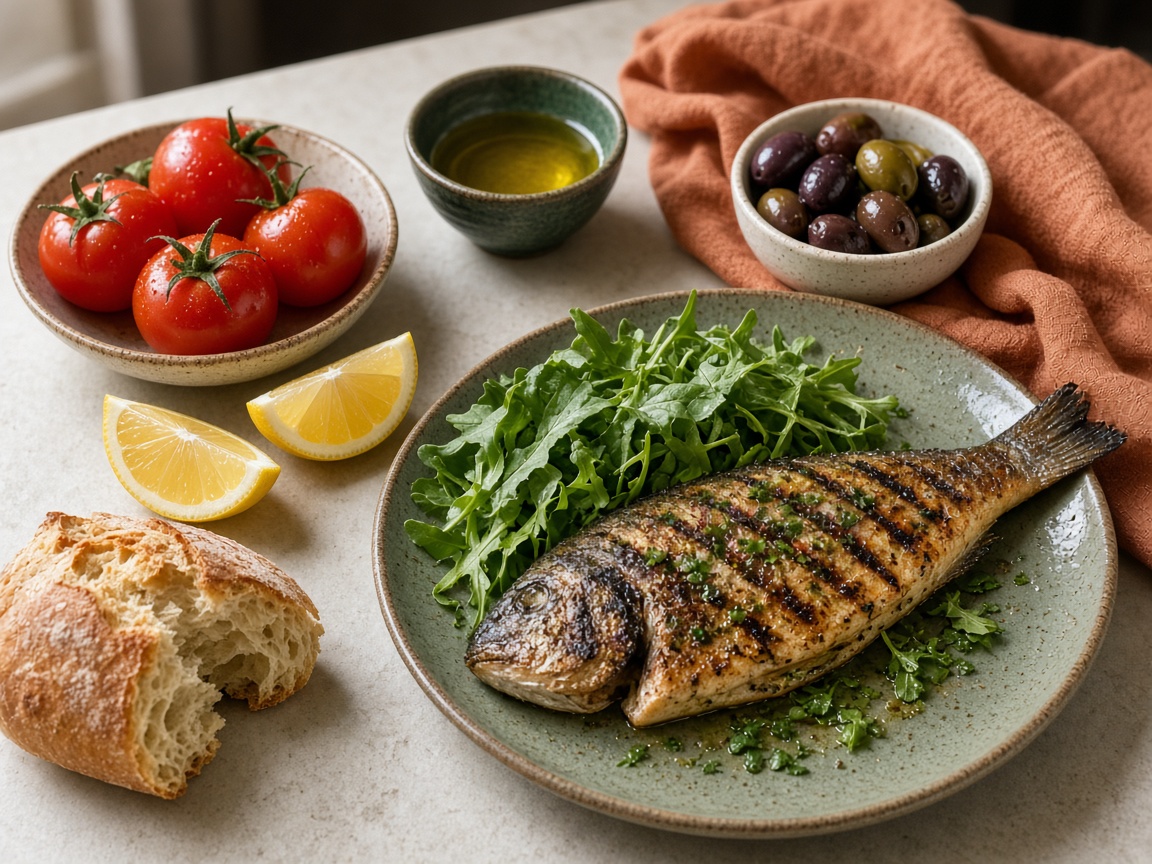
One role on the plate, a different fat
MyPlate asks for varied protein foods: fish, poultry, meat, eggs, beans, nuts, soy. Both fish and sausage can formally tick “some protein food” at lunch. The difference starts immediately after that tick. The WHO fact sheet prefers unsaturated fats — fish, avocado, nuts, vegetable oils — to saturated fats and industrial trans fats.
WHO keeps saturated fat under 10% of energy, total fat under 30%, and industrial trans fat under 1%. Sausage more often leans on saturated fat than fish with vegetable oil, or fish simply baked. Swapping one for the other keeps the role of a protein food and changes the type of fat, rather than “eating less protein.”
Salt that fish does not have to copy
WHO keeps salt under 5 g a day. Sausage, frankfurters, and salt pork take a noticeable part of that gram before soup or bread even appears. Fish without a heavy cure does not have to copy that gram. Sodium in the US guidelines is a separate limit, under 2,300 mg a day, and this page does not equate it with 5 g of salt.
The DASH plan explicitly places fish and poultry on the useful side and asks for less fatty meat. Sodium there is 2,300 mg or a 1,500 mg version. It is a blood-pressure plan, not a gain scheme and not permission to eat everything. Sausage every day for the sake of a “plus” does not fit DASH, even if the protein role on the plate is formally filled.
The Mediterranean context is not a gain protocol
PREDIMED, Estruch and colleagues, NEJM, looked at adults who already had high cardiovascular risk. A Mediterranean pattern with extra-virgin olive oil or with nuts was compared with advice to eat less fat. The Mediterranean groups had fewer major cardiovascular events.
The 2013 paper was retracted and republished in 2018 because of randomization problems, and the republication kept the finding of fewer events. It is not a weight-loss trial and not a weight-gain trial. This page gives neither a percent nor a hazard ratio. Fish in that pattern sits beside oil and nuts as part of the picture, not as a promise of kilograms.
Extra energy without a daily sausage
If more energy is needed, it is added with foods the fact sheet already prefers: fish, vegetable oil, nuts, grain, and vegetables of at least 400 g. Sausage is not the only way to make a plate more filling. The saturated-fat share and the salt run out before the story of hunger does.
The safe protein level for adults, 0.83 g per kg per day from FAO/WHO/UNU, is not a muscle target here: it is a population figure. Fish does not have to chase it with a heap of portions, and sausage does not either. Kidney disease changes the figure through a clinician. An ordinary portion of fish instead of sausage already changes the fat and the salt, without changing the meaning of a protein food.
What this text draws on
- WHO Healthy diet fact sheet: energy intake in balance with expenditure; fruit and vegetables ≥400 g/day; free sugars <10% of energy (below 5% for further benefit); fat <30%; saturated fat <10%; trans fat <1%; salt <5 g/day; unsaturated fats (fish, avocado, nuts, vegetable oils) preferred to saturated and industrial trans fats.
- Dietary Guidelines for Americans, 2020–2025, and USDA MyPlate: a nutrient-dense pattern shaped by culture and budget; added sugars <10% of calories from age 2; saturated fat <10%; sodium <2,300 mg/day; half the plate fruits and vegetables; half of grains whole; varied protein foods; low-fat or fat-free dairy or fortified soy. Drinking less is better than drinking more; not drinking is an option.
- NHLBI DASH Eating Plan: vegetables, fruits, whole grains, low-fat dairy, fish, poultry, beans, nuts, vegetable oils; less fatty meat, sweets, and sugary drinks; sodium 2,300 mg or a 1,500 mg version. Studied for blood pressure, not as a crash plan and not as permission to eat everything.
- PREDIMED, Estruch et al., NEJM: adults who already had high cardiovascular risk. A Mediterranean pattern with extra-virgin olive oil or with nuts was compared with advice to eat less fat. The Mediterranean groups had fewer major cardiovascular events. The 2013 paper was retracted and republished in 2018 because of randomization problems; the republication kept the finding of fewer events. Not a weight-loss trial. Do not give a percent or a hazard ratio.
- FAO/WHO/UNU, 2007: the safe protein level for adults is 0.83 g per kg body weight per day. A population figure, not a muscle-gain plan. Kidney disease changes it through a clinician.
A short paraphrase of open guides and reviews (WHO, national recommendations, peer‑reviewed summaries). Not a quotation and not a treatment protocol.
Short answers
Can sausage be replaced with fish and still count as a protein food?
Yes. Both can fill the protein-food role on MyPlate. Fish is closer to the unsaturated fats WHO prefers, and it usually carries less salt.
Did PREDIMED prove that fish builds weight better than sausage?
No. It studied cardiovascular events in people who already had high risk, not a gain. No percent and no hazard ratio are given.