Grain on the same plate
Grain takes the grain place on the plate, and the American guidelines ask that half of the day's grains be whole. That place does not erase the vegetable half: rice, buckwheat, or pasta sit beside the vegetable, not in its stead.
Where the grain sits
If rice covers the whole plate and the cabbage fits in one spoon, the MyPlate half is already lost, even though the lunch feels filling and finished. Grain is needed as its own part, not as a cover under which the vegetable disappears. A cuisine chooses the grain itself: rice, buckwheat, oats, bulgur, pasta, or bread. The choice of grain does not cancel the fruit and vegetable side.
A nutrient-dense pattern in the American guidelines is built from several groups at once, with the usual cooking and the budget in mind. A cheap grain fits as well as an expensive one when a vegetable is beside it, not only oil. A protein food also stays in its place and does not have to hide so the grain can "win. " The plate is read by shares, not by whichever food was piled highest.
Half the grains whole
The rule is about the day's grains, not a demand that every bite be dark. Morning oats and a serving of ordinary rice later can move the day toward half whole grains, if whole grain really is half of the grain food. A refined grain is still a grain food. It simply does not, by itself, close the line that says half should be whole.
Whole grain is also closer to fiber, which WHO takes from food at not less than 25 g a day for adults. This article does not assign how many grams of fiber sit in a particular porridge: that figure is not in the guides. What exists is a place for the food. Porridge from whole grain helps that place, and vegetables, fruit, and beans help beside it, or there is nothing from which to build 25 g.
A dry row and a cooked plate
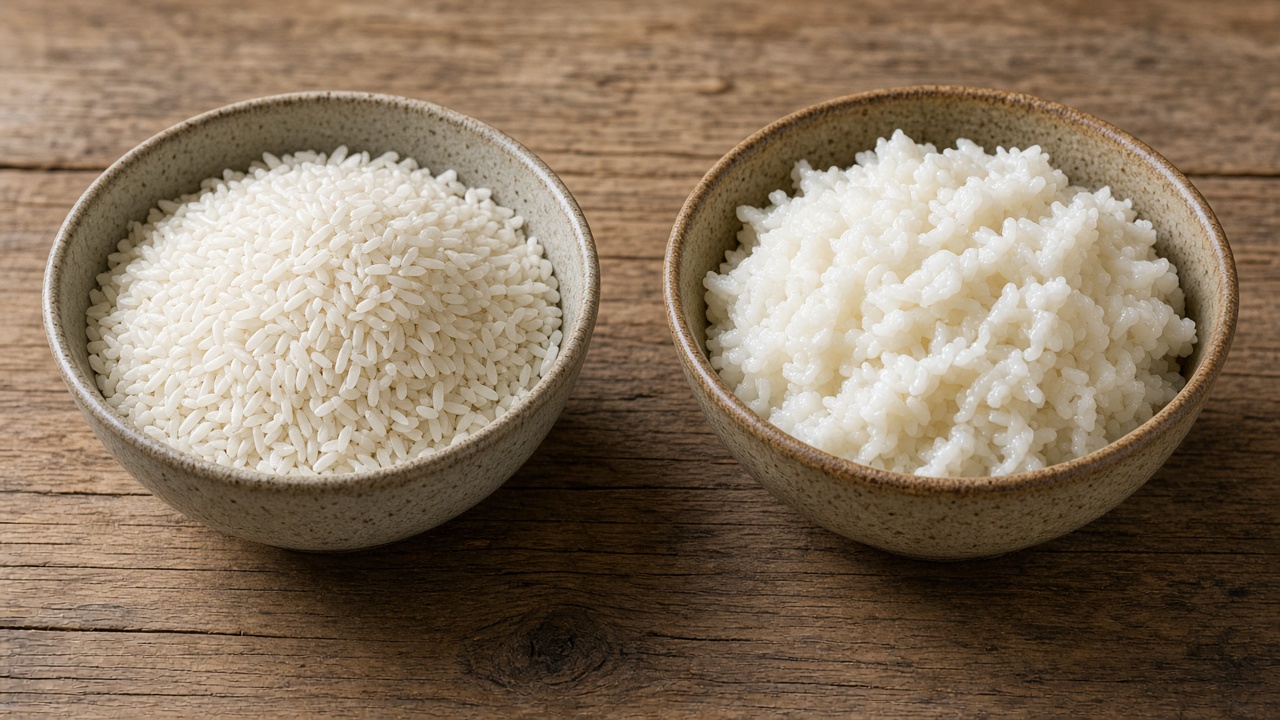
In USDA FoodData Central the guides are per 100 g, and brands differ. A dry-food row is not a cooked portion, because water changes the weight. A factor such as "rice triples" is not used here and is not offered. Writing dry grams onto a plate where the grain has already taken up water means describing a different food.
Boiled grain and grain with oil are not one row either. Water and a spoon of fat change both the weight and the meaning of the portion, even when the dish keeps its name. Energy on a label, when there is a label, is stated per labeled serving, and a package can contain several servings. The serving on the pack is not always 100 g and not always the mound that was served at supper.
Sauce does not become grain
The word "whole" does not cancel the broth the porridge was salted in, or the fat it was fried in. Salt in that grain belongs to the WHO limit: less than 5 g of salt a day. Sodium under 2,300 mg a day in the American guidelines is a different line, in different units, and this article does not translate grams of salt into milligrams of sodium. Sauce is counted as sauce, and grain as grain.
Fat stays under 30% of energy, saturated fat under 10%, industrial trans fat under 1%. A pilaf dressed with a large amount of animal fat can be a whole grain and still leave the saturated-fat share. WHO prefers unsaturated fats: fish, avocado, nuts, vegetable oils. The grain does not make that choice by itself; the food it was dressed with makes it.
What this text draws on
- Dietary Guidelines for Americans, 2020–2025, and USDA MyPlate: a nutrient-dense pattern shaped by culture and budget; added sugars <10% of calories from age 2; saturated fat <10%; sodium <2,300 mg/day; half the plate fruits and vegetables; half of grains whole; varied protein foods; low-fat or fat-free dairy or fortified soy. Drinking less is better than drinking more; not drinking is an option.
- WHO Healthy diet fact sheet: energy intake in balance with expenditure; fruit and vegetables ≥400 g/day; free sugars <10% of energy (below 5% for further benefit); fat <30%; saturated fat <10%; trans fat <1%; salt <5 g/day; unsaturated fats (fish, avocado, nuts, vegetable oils) preferred to saturated and industrial trans fats.
- WHO carbohydrate guideline, 2023: at least 25 g of fiber a day for adults, from food.
- USDA FoodData Central: guides per 100 g; brands differ. A dry-food row is not a cooked portion, because water changes the weight. Do not use a “rice triples” factor.
- FDA Nutrition Facts: energy is stated per labeled serving; a package can contain several servings. A labeled serving is not always 100 g.
A short paraphrase of open guides and reviews (WHO, national recommendations, peer‑reviewed summaries). Not a quotation and not a treatment protocol.
Short answers
Can a plate of only whole grain be called the vegetable half?
No. Whole grain covers the grain line, while the MyPlate half and the WHO 400 g refer to fruit and vegetables. Grain does not replace them.
Why is a dry grain in a database not the porridge on the plate?
Water changes the weight, so a dry-food row and a cooked portion are different things. This article does not use a "rice triples" factor.